

2025 was a year of renewal and rethinking for our coalition. Despite widespread political upheaval and disruptions to global development funding, it provided us with new momentum and vigor to strengthen our position as a global solidarity network that delivers critical and strategic advancements for the rights and development of Indigenous Peoples (IP), local communities (LC), and Afro-descendent Peoples (ADP) across the world.
We began by celebrating the 20th anniversary of RRI’s founding, which was a vital opportunity to take stock of our collective accomplishments and challenges over the last two decades and reflect on our place in the new global realities of the sector. We engaged in thoughtful conversations throughout the year with RRI’s founders, earliest champions, Indigenous elders, women leaders, youth, and our global allies to map the coalition’s journey over the last 20 years. We also commissioned an independent review of RRI’s progress toward achieving its current five-year Strategic Program, which expires in 2027.
2025 was a year of renewal and rethinking for our coalition. Despite widespread political upheaval and disruptions to global development funding, it provided us with new momentum and vigor to strengthen our position as a global solidarity network that delivers critical and strategic advancements for the rights and development of Indigenous Peoples (IP), local communities (LC), and Afro-descendent Peoples (ADP) across the world.
An Indigenous Maasai
man in traditional
dress in Kenya.
Photo: Asha Stuart
RRI, 2025
RRI supports the collective tenure and livelihood rights of Indigenous Peoples (IPs), Afro-descendant Peoples (ADPs), and local communities (LCs) by promoting greater global commitment and action towards policy, market, and legal reforms that secure their rights to own, control, and benefit from natural resources, especially land and forests. To advance this mission, RRI contributes to three global goals:
Substantially increase the land area under local ownership and administration, with secure rights to manage, conserve, use, and trade products and services.
Increase the adoption of progressive laws, regulations, and practices that promote the customary and statutory tenure rights of IPs, ADPs, and LCs, particularly women and youth.
Dramatically improve
the socioeconomic status of IPs, ADPs, and LCs based on their self-determined priorities.
We deliver on this mission by:
Building evidence and contributing strategic analysis to track land rights and analyze the connection between secure rights and positive climate and sustainable development outcomes.
Convening networks, fostering dialogue, and improving mutual understanding and respect among diverse stakeholders including rightsholders, government, the private sector, and broader civil society; and creating space for sharing lessons and co-creating common advocacy objectives.
Strengthening the capacity of IP, ADP and LC organizations, networks and coalitions to share experience, develop and advance common advocacy positions in local, national, regional, and global fora.
Advancing and increasing direct finance to rightsholders, with a particular focus on women, while supporting them in their efforts to hold governments and multilateral organizations accountable for global funding commitments.
Gayanimaya Tamang, a member of the Lag Lage Pacha Community
Forest User Group near Kathmandu, fertilizes the soil.
Photo: Asha Stuart, RRI, 2025.
RRI supports the collective tenure and livelihood rights of Indigenous Peoples (IPs), Afro-descendant Peoples (ADPs), and local communities (LCs) by promoting greater global commitment and action towards policy, market, and legal reforms that secure their rights to own, control, and benefit from natural resources, especially land and forests. To advance this mission, RRI contributes to three global goals:
Substantially increase the land area under local ownership and administration, with secure rights to manage, conserve, use, and trade products and services.
Increase the adoption of progressive laws, regulations, and practices that promote the customary and statutory tenure rights of IPs, ADPs, and LCs, particularly women and youth.
Dramatically improve the socioeconomic status of IPs, ADPs, and LCs based on their self-determined priorities.
We deliver on this mission by:
Building evidence and contributing strategic analysis to track land rights and analyze the connection between secure rights and positive climate and sustainable development outcomes.
Convening networks, fostering dialogue, and improving mutual understanding and respect among diverse stakeholders, including rightsholders, government, the private sector, and broader civil society; and creating space for sharing lessons and co-creating common advocacy objectives.
Strengthening the capacity of IP, ADP, and LC organizations, networks, and coalitions to share experiences and develop and advance common advocacy positions in local, national, regional, and global fora.
Advancing and increasing direct finance to rightsholders, with a particular focus on women, while supporting them in their efforts to hold governments and multilateral organizations accountable for global funding commitments.
Bolivia
Brazil
Colombia
Costa Rica
Dominican Republic
Ecuador
Guatemala
Honduras
Mexico
Panama
Peru
Burundi
Cameroon
Central African Republic
Chad
Democratic Republic of the Congo
Gabon
Kenya
Liberia
Namibia
Republic of Congo
Rwanda
Sierra Leone
Tanzania
Togo
Uganda
India
Indonesia
Nepal
Philippines
Thailand
Women gather to prepare
food outside of Tebat
Pulau, Sumatra, Indonesia
Photo: Jacob Maentz
RRI, 2022
Bolivia
Brazil
Colombia
Costa Rica
Dominican Republic
Ecuador
Guatemala
Honduras
Mexico
Panama
Peru
Burundi
Cameroon
Central African
Republic
Chad
Democratic Republic of the Congo
Gabon
Kenya
Liberia
Namibia
Republic of Congo
Rwanda
Sierra Leone
Tanzania
Togo
Uganda
India
Indonesia
Nepal
Philippines
Thailand
Aerial view of the
Potaro River in Guyana,
South America.
Photo: iStock
RRI provides financial support, solidarity, technical and strategic analysis, and fiscal sponsorship to its partners and allies in the Global South.*
hectares of land titled to IPs, LCs, and ADPs
hectares of land for which legal titles were requested, prepared by IPs, LCs, and ADPs and submitted to government for approval
hectares of land mapped by IPs, ADPs, and LCs using inclusive community processes
land conflicts mediated or resolved on IP, LC, ADP collective lands
policy analyses and recommendations developed by partners and collaborators to inform national land/forest governance and reform processes
community monitoring mechanisms operationalized using participatory processes
members of IPs and LCs trained in tenure rights, land governance, advocacy and community leadership
*Note: The tenure data reported here covers the period 2022-2025. This is an impact indicator for RRI within the framework of our Strategic Program IV.
As such, we collect data and report against the timeframe and anticipated contribution to impact of that framework.
RRI provides financial support, solidarity, technical and strategic analysis, and fiscal sponsorship to its partners and allies in the Global South.*
hectares of land titled to IPs, LCs, and ADPs
hectares of land for which legal titles were requested, prepared by IPs, LCs, and ADPs and submitted to government for approval
hectares of land mapped by IPs, ADPs, and LCs using inclusive community processes
land conflicts mediated or resolved on IP, LC, ADP collective lands
policy analyses and recommendations developed by partners and collaborators to inform national land/forest governance and reform processes
community monitoring mechanisms operationalized using participatory processes
members of IPs and LCs trained in tenure rights, land governance, advocacy and community leadership
*Note: The tenure data reported here covers the period 2022-2025. This is an impact indicator for RRI within the framework of our Strategic Program IV. As such, we collect data and report against the timeframe and anticipated contribution to impact of that framework.
81 active projects supporting 71 partners in 20 countries, including 23 women-led organizations, mobilizing over $10 million in direct support.
Over 50% of these projects advanced collective tenure rights, while others focused on improved conservation, gender justice, and support to local economies.
$1.8 billion pledged at COP30 for forest and land tenure, influenced by collective and coordinated actions by the RRI coalition and its allies.
An Indigenous Maasai
shows their land title
deed, Kenya.
Photo: Tony Wild
RRI, 2023
In July 2025, RRI convened its first Global Youth Forum in Bali, Indonesia, in collaboration with Aliansi Masyarakat Adat Nusantara (AMAN) and Barisan Pemuda Adat Nusantara (BPAN). This historic gathering brought together 55 IP, ADP, and LC youth leaders from 28 countries across Asia…
In 2025, the Women in Global South Alliance (WiGSA) strengthened its internal cohesion, public identity, and global positioning as a cross-continental solidarity network advocating for women’s tenure rights and direct access to finance. WiGSA received a record number of membership requests and expanded to 26 member organizations…
RRI’s 20th Anniversary convening in Kathmandu, Nepal, brought together more than 240 rightsholders, allies, founders, and decision-makers from over 40 countries. Organized in partnership with seven local partners (Federation of Community Forestry Users Nepal; Nepal Federation of Indigenous Nationalities; Green…
Home to 60 percent of the Congo Basin—the world’s largest carbon sink—the DRC has long faced conflicts and deforestation linked to the absence of a clear land-use framework. In July 2025, the President of the DRC signed into law the country’s first-ever Land Use Planning Law, marking a historic step toward inclusive, rights-based…
In Kenya, RRI supported a successful community-led resistance campaign by the deCOALonize movement to stop a proposed coal plant in Lamu and new coal prospecting in Kitui. RRI enabled over 225 community members, including women and youth, to access the support and tools needed to speak out against harmful coal developments, contributing to a historic court…
At the 5th African Land Institutions Network for Community Rights (ALIN) Conference in October 2025, RRI partnered with the Sierra Leone Ministry of Lands, Housing, and Country Planning and the Sierra Leone Land Alliance to convene government representatives from over 16 African countries, along with partners and allies. RRI and its partners played a central role in engaging participants…
The Bolivian Agrarian and Environmental Court admitted the lawsuit and issued a set of precautionary measures in favor of the Madre de Dios River and the communities of Multiethnic Territory II (TIM II). This decision responded to a Preventive Environmental Action filed before the Court against the Mining Administrative Jurisdictional Authority (AJAM) and the mining cooperative…
In Ecuador, advocacy support and funding from RRI’s Strategic Response Mechanism enabled the A’i Kofan Indigenous Nationality, through the NOA’IKE organization, to secure rights to conserve, manage, and administer 20,000 hectares of ancestral territory inside the Cuyabeno Wildlife…
The Federation of Community Forestry Users Nepal (FECOFUN) secured government approval for six Community Forest Operational Plans (CFOPs) in Gandaki Province, integrating Sustainable Forest Management guidelines for the first time. Many Community Forest User Groups had previously been unable to renew outdated plans, leaving forests unmanaged and limiting women’s and…
On December 17, 2025, a major victory for Indigenous Peoples’ rights was achieved in Indonesia’s North Lombok Regency: The official recognition of 12 Indigenous territories across the regency’s five
districts. Signed by Regent Najmul Akhyar, the decree acknowledges 51,158 hectares of Indigenous lands, formally documenting them in government records and affirming state protection of…
Since launching in 2022, RRI’s Indigenous-led funding mechanism, CLARIFI, has funded 186 locally led projects across 29 countries, mobilizing more than $40 million in direct financing for Indigenous Peoples, local communities, and Afro-descendant…
In Bolivia, CLARIFI’s sustained support to RRI coalition members advanced territorial rights and amplified Indigenous voices. Years-long Indigenous leadership led to the designation of 283,179 hectares of the Tacana II Indigenous territory as original community land (Tierras Comunitarias de Origen, in Spanish). This significant victory for Indigenous rightsholders was achieved under…
In the DRC, the Congo Resources Institute (CRI) supported the establishment of community forest management across 15,807.53 hectares, helping the communities of Kishiongo and Kasambanza map their lands and apply for community concession titles following participatory mapping. The project strengthened local ownership and collaboration between customary authorities and…
In Ecuador, funding from RRI’s Strategic Response Mechanism and advocacy support enabled the A’i Kofan Indigenous Nationality, through the NOA’IKE organization, to secure rights to conserve, manage, and administer 20,000 hectares of ancestral territory inside the Cuyabeno Wildlife Production Reserve. A cooperation agreement with the Ministry of Environment…
As with legal reforms, changes to the global funding ecosystem don’t happen overnight. They are backed by long-term, sustained advocacy that often takes place along the sidelines of major platforms well before change becomes…
In May 2025, RRI joined REPALEAC and the GATC to co-organize the First Global Congress of Indigenous Peoples and Local Communities from the Forest Basins, convening 156 representatives from Africa, Asia, Mesoamerica, and South America in Brazzaville. Participants published the Brazzaville Declaration and used the document to advocate for their rights in the lead-up…
RRI’s flagship gender analysis, Resilience and Resistance, provided an updated assessment of women’s legally recognized rights to community forests across 35 countries as of 2024. The report examined legal reforms since 2016 and provided concrete evidence for IP, ADP, and LC women leaders to challenge discriminatory laws and advocate for…
In 2025, RRI published a study on Enabling Pathways for Rights-based Community-led Conservation, assessing legal frameworks and biodiversity strategies in 30 countries. Developed with the ICCA Consortium and Forest Peoples Programme, the analysis found that while legal pathways for recognized community conservation exist, they remain underused…
In 2025, RRI marked its 20th anniversary by reflecting on two decades of coalition impact and lessons learned. After convening founding members and current partners in Nepal at its 20th anniversary celebration, RRI published a landmark achievements report and produced…
Coalition members pose
for a photo at RRI’s 20th
anniversary celebration in
Kathmandu, Nepal.
Photo: Sandesh Chaudhary
RRI, 2025

Capturing two decades of RRI’s work across continents, cultures, and movements to build a more just and sustainable planet.

Yearly update on the state of donor funding for Indigenous Peoples, Afro-descendant Peoples, and local communities in tropical countries, including an expanded scope of funding for ecosystems beyond forests.
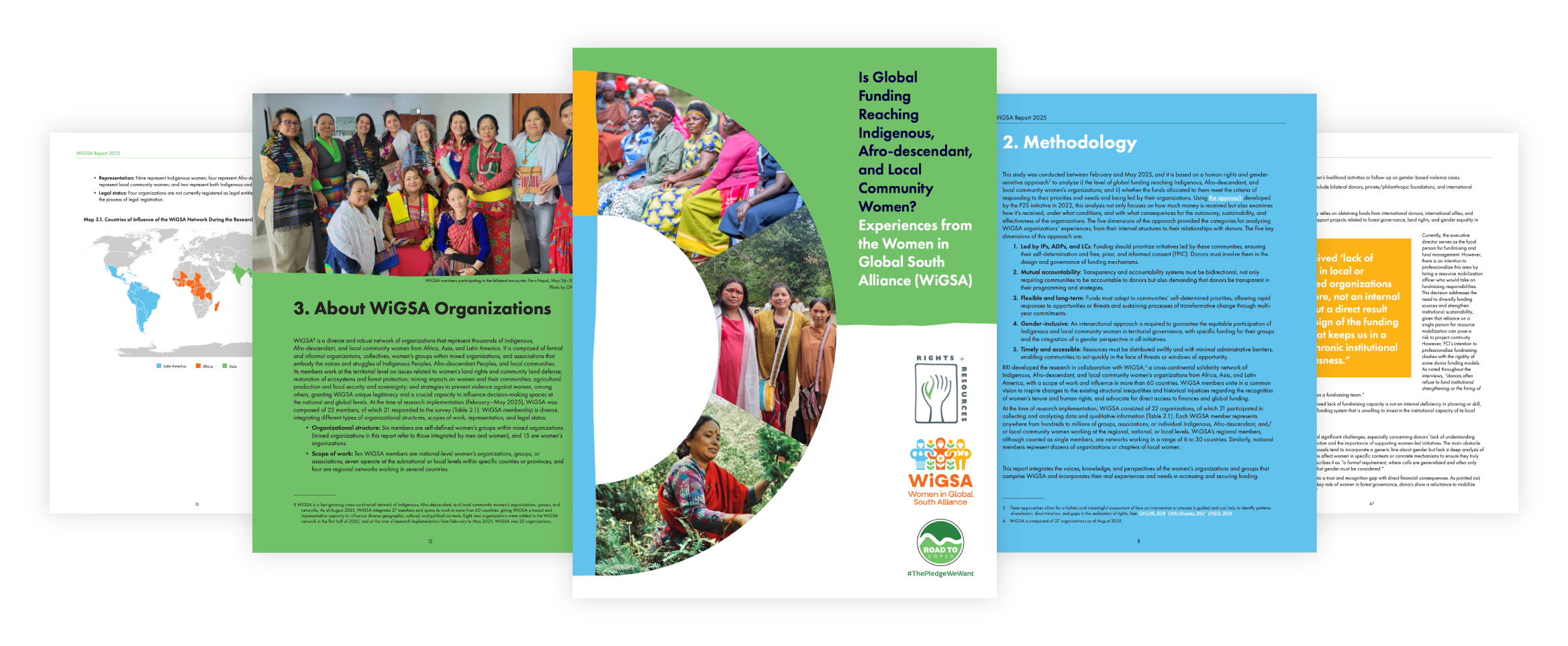
An analysis showcasing the lack of funding for Indigenous, Afro-descendant, and local community women and the need for including a gender-responsive perspective in funding commitments.

Best practices from communities defending their territories and cultures, from the Maya Biosphere Reserve in Guatemala to the Enggano island in Indonesia and India's Bastar region.
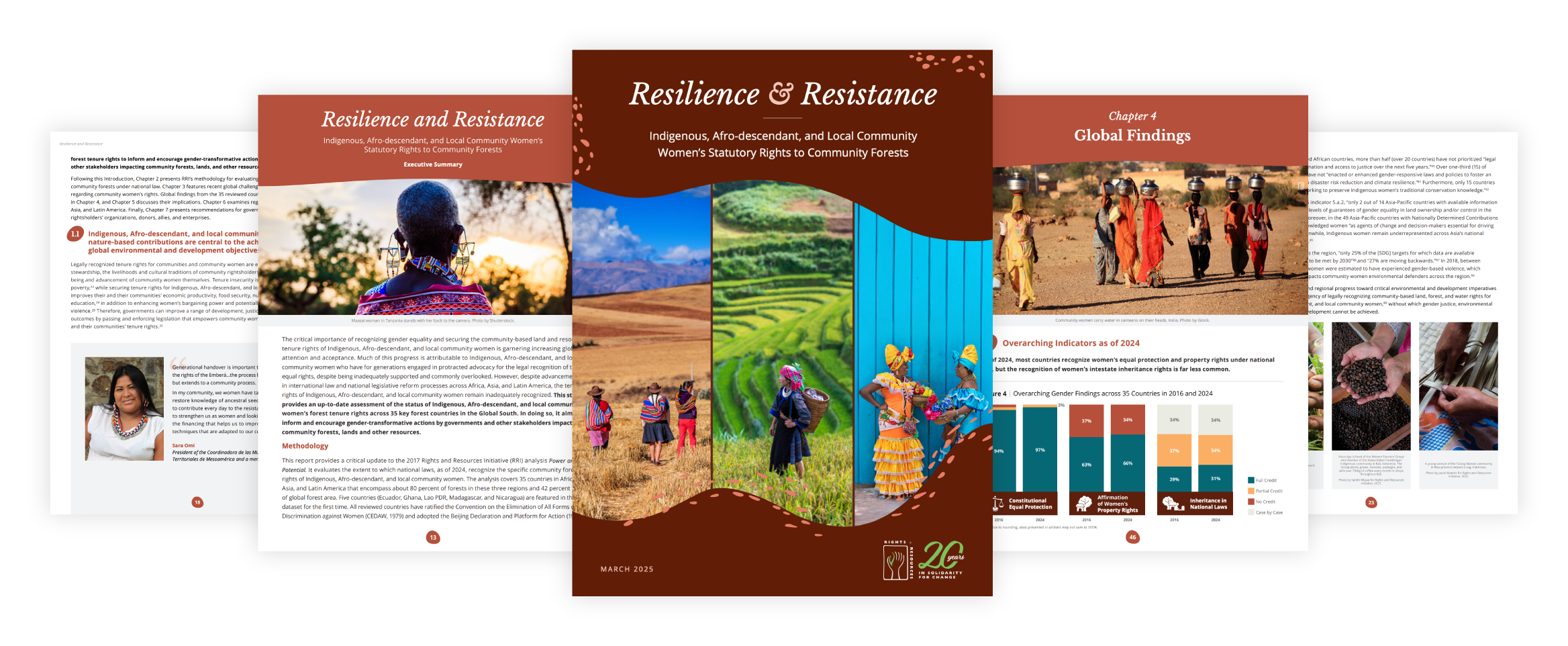
RRI’s latest assessment of the status of Indigenous, Afro-descendant, and local community women’s forest tenure rights across 35 forest countries in the Global South.

An analysis of the current state of recognition of communities’ carbon rights in 33 countries within the context of the Paris Agreement.

A practical framework outlining ideal Nationally Determined Contribution (NDC) commitments developed under the Paris Agreement, identifying concrete entry points to translate rights-based principles into measurable climate action.

This study combines census, geospatial, and climate data from 26 countries with communities’ stories to identify the impacts of climate change on the marine and coastal territories used by Afro-descendant Peoples.

Capturing two decades of RRI’s work across continents, cultures, and movements to build a more just and sustainable planet.

Yearly update on the state of donor funding for Indigenous Peoples, Afro-descendant Peoples, and local communities in tropical countries, including an expanded scope of funding for ecosystems beyond forests.

An analysis showcasing the lack of funding for Indigenous, Afro-descendant, and local community women and the need for including a gender-responsive perspective in funding commitments.

Best practices from communities defending their territories and cultures, from the Maya Biosphere Reserve in Guatemala to the Enggano island in Indonesia and India's Bastar region.

RRI’s latest assessment of the status of Indigenous, Afro-descendant, and local community women’s forest tenure rights across 35 forest countries in the Global South.

An analysis of the current state of recognition of communities’ carbon rights in 33 countries within the context of the Paris Agreement.

A practical framework outlining ideal Nationally Determined Contribution (NDC) commitments developed under the Paris Agreement, identifying concrete entry points to translate rights-based principles into measurable climate action.

This study combines census, geospatial, and climate data from 26 countries with communities’ stories to identify the impacts of climate change on the marine and coastal territories used by Afro-descendant Peoples.
Our collective efforts in 2025 reinforced the following lessons that we are continuously reflecting on and increasingly integrating into our programming.
Improved direct finance to IP, ADP, and LC organizations requires simplified grant eligibility requirements, as well as streamlined and more flexible grant management procedures, if the aim is to reduce the administrative burden on grantees and reach smaller, less experienced organizations. By combining capacity strengthening as part of our grant management support, we take grantee organizations where they are and aim to support them along pathways toward improved viability, visibility, and increased funding diversification. In addition to direct grants, building the capacity of territorial funds for grant-making—as vehicles for increased ownership and improved financial support for territorial agendas—is a crucial component for improved and more accessible finance for IPs, ADPs, and LCs.
Human rights are indivisible; therefore, the promotion and defense of rights must necessarily be holistic and multi-faceted. Advancing collective tenure rights must go hand-in-hand with advancing the well-being of IPs, ADPs, and LCs by supporting sustainable local economies and inclusive and robust governance structures while favoring the equitable participation of women, men, and youth. Increasingly, RRI’s support involves a more comprehensive and complex response to IPs’, ADPs’, and LCs’ overall well-being.
Joint advocacy and collective action require ongoing and sustained support to enable IP, ADP, and LC coalitions and networks to exchange, coordinate, and convene between and beyond the framework of established national, regional, and global forums. Strengthening IP, ADP, and LC coalitions, particularly those led by women and youth, requires dedicated and sustained coaching, convening, and technical and organizational strengthening support to foster their emerging visibility and influence.
Defending land rights often puts activists on the frontlines of conflict. The collective protection of land rights defenders needs increasingly to be seen as a key component of effective land governance. The safety of women and youth land defenders is particularly at risk given their multi-faceted social vulnerability. RRI is increasing its support for community vigilance networks, alliances with protection organizations, legal defense for defenders, and advocacy for increased local safeguards as threats to these actors continue to increase.
Maria Community
Indigenous School in
Indonesia.
Photo: Rachel Watson
Campaign for Nature,
RRI, and CLARIFI, 2024.
A woman bends over a fire
outside a shelter, Honduras.
Photo: If Not Us Then Who?
Makes strategic decisions for the coalition regarding governance, finances, administration, expansion or review of programs, funding mechanisms, legal matters, and risk management.
Oversees coalition management, approves new partners, and votes on partner representatives to the Board. Advises on ad hoc issues such as sign-on requests, crisis management, and programmatic guidance.
Organizations that engage with RRI’s programs, such as co-authoring strategic analyses; co-hosting workshops, webinars, and events; joining funding mechanisms, strategic planning processes, and other RRI activities.
Provides expert support to the RRI coalition in their areas of expertise. Shares thought leadership and guidance to the coalition via workshops, webinars, articles, and reports.
Provides ad hoc advice to the RRI Coordinator and President and RRI’s leadership. They are prominent voices in
the land rights and environmental sector, including founders, senior leaders/elders from Indigenous, Afro-descendent, and local communities, former Board Chairs, and prominent individuals.
RRI staff responsible for program coordination and implementation.
In 2025, the RRI coalition reviewed its Memorandum of Understanding (MOU) that establishes the roles and responsibilities of the different coalition bodies. The MOU renewal happens every five years and is an opportunity to reflect on the composition of the coalition. For this cycle, through extensive consultations with RRI’s partners, Board of Directors, fellows, coalition members and the Secretariat, we agreed to dramatically expand the coalition from 20 to more than 80 partners. The coalition also agreed to create an Advisory Council and a Council of Elders to manage and guide the coalition’s growth.
The Secretariat, led by the RRI President and Coordinator, serves as the coalition’s coordinating mechanism and is supported by senior and junior professionals, country and regional experts, and field leaders. It builds evidence to advance rights recognition, conducts research and advocacy, and promotes findings globally. It convenes diverse stakeholders, fosters collaboration, and supports tenure reform through country-level engagement. The Secretariat incubates initiatives that fill gaps in community land rights efforts and provides rapid response funding through the SRM. It also leads monitoring, evaluation, and learning, maintains donor relationships, diversifies revenue, and operates under the oversight of the RRI Board of Directors.
RRI is known for incubating and supporting alliances and initiatives to elevate the voices of women and youth and to engage with specific stakeholders to advance land and tenure rights. These include: the Women in Global South Alliance (WiGSA), a network of public forest agency leaders called MegaFlorestais, the Interlaken Group of private sector actors, the Path to Scale, which seeks to hold donors accountable to global funding pledges, and a Global Youth Network that is advancing a roadmap developed at a Global Youth Congress hosted by RRI in 2025.
In addition to regional and thematic programs, RRI has created direct funding mechanisms to support IP, ADP, and LC communities and organizations. The Community Land Rights and Conservation Finance Initiative (CLARIFI) is a direct financing mechanism that supports the self determined priorities of rightsholder communities by acting as a trusted bridge between communities and funders. The Strategic Response Mechanism (SRM) is intentionally designed to provide timely, flexible responses to emerging and urgent opportunities and threats. It complements the annual program planning process by enabling rapid funding for unexpected opportunities.
in secured funding
in unsecured funding
in secured funding
in unsecured funding
projects
countries
in approved funding
projects
countries
*All totals are in USD
in secured funding
in unsecured funding
in secured funding
in unsecured funding
projects
countries
in approved funding
projects
countries
*All totals are in USD